How to Pray the Divine Mercy Chaplet, Step by Step
Every word on every bead, the 3 o'clock Hour of Mercy, the nine-day novena and what St. Faustina actually wrote
The Divine Mercy Chaplet is a short Catholic prayer prayed on ordinary rosary beads, in which you offer Jesus Christ to the Father and ask mercy "on us and on the whole world". St. Faustina Kowalska recorded receiving it in Vilnius in September 1935 (Diary 474 to 476). You begin with the Sign of the Cross, an Our Father, a Hail Mary and the Apostles' Creed, pray "Eternal Father..." on each large bead and "For the sake of His sorrowful Passion..." on each small bead, and finish with "Holy God" three times. The whole chaplet takes about fifteen minutes.
This page gives you every word, bead by bead, then the 3 o'clock Hour of Mercy, the nine-day novena from Good Friday to Divine Mercy Sunday, and the promises recorded in the Diary with their paragraph numbers. Get your beads now. No one knows the day or the hour (Mark 13:32), and mercy is offered today. Pray one chaplet before you close this page.
Pray the chaplet every day, including the days you forget. Pro gives you audio-guided prayer sessions for anxiety, healing and protection, calming audio devotionals for the commute and for 3 o'clock at your desk, the full Bible study library, a circle of believers to pray with, and counselling with a qualified therapist. Get Pro. $49 once, lifetime access, 30-day money-back guarantee.
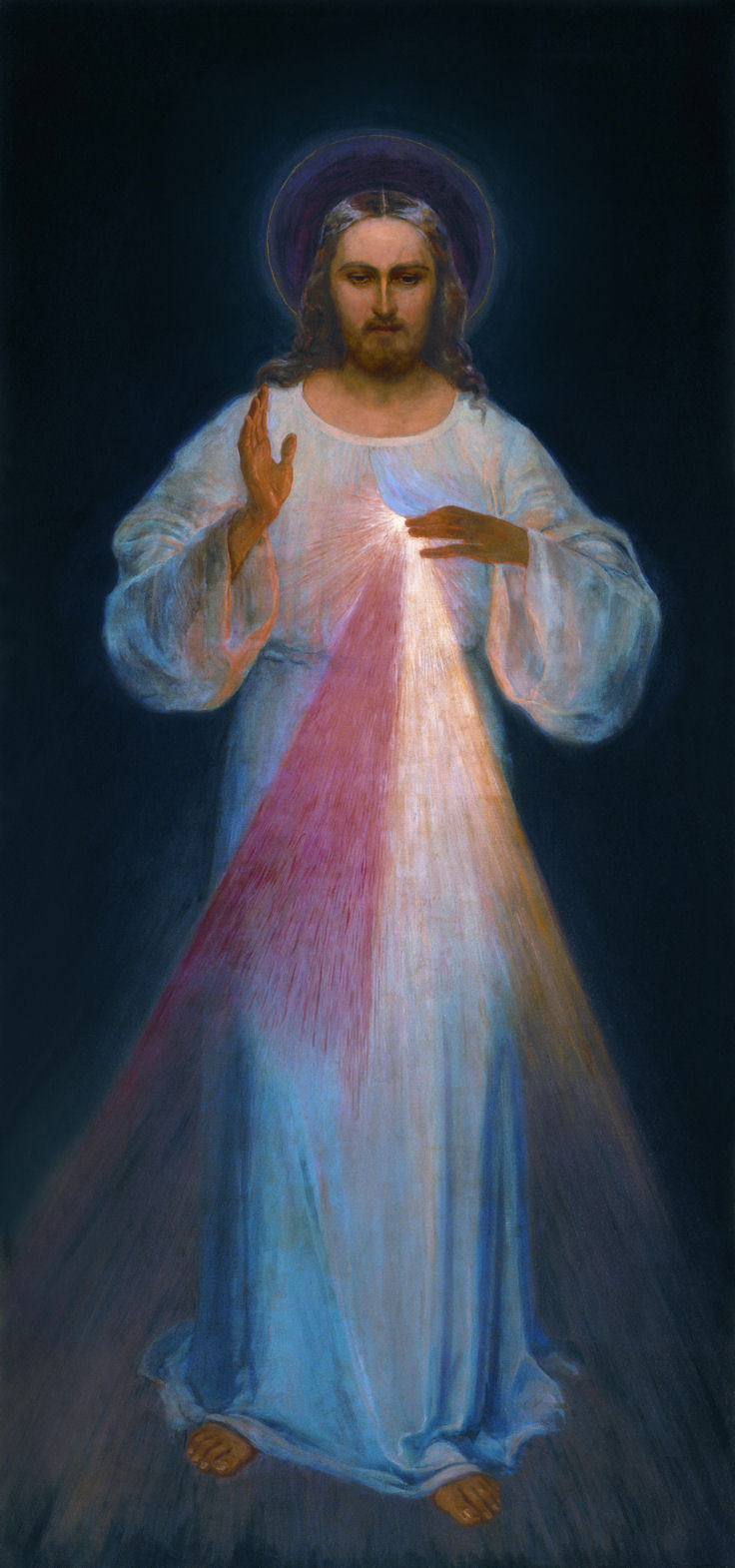
1. What Is the Divine Mercy Chaplet?
The Divine Mercy Chaplet is an intercessory prayer that offers the Body and Blood, Soul and Divinity of Jesus to God the Father in atonement for sin, and begs mercy for the whole world. It belongs to the Divine Mercy devotion that the Church received through St. Faustina Kowalska (1905 to 1938), a Polish nun of the Congregation of the Sisters of Our Lady of Mercy, whom St. John Paul II canonised on 30 April 2000.
Every large bead is an offering and every small bead is a plea: you hold up the Passion and ask the Father to look at His Son and have mercy. That is the logic of the Mass, prayed on your fingers, and because it asks for "the whole world" every time, it makes you an intercessor for people you will never meet.
Here is the hard thing. Most of us treat mercy as an emergency service, called on when we are caught and forgotten until the next crisis. The chaplet puts mercy on your lips fifty times a day until you believe it and start to give it. If you carry a sin you think is too big, this prayer was written for you.
The Church approves the devotion and has written it into her calendar with Divine Mercy Sunday. Like every private revelation, the Diary adds nothing to the faith Catholics must believe, and no Catholic is obliged to pray the chaplet (CCC 67). The Church holds it up because it leads straight back to the Gospel: "The Gospel is the revelation in Jesus Christ of God's mercy to sinners" (CCC 1846). Meet the woman behind it in our profile of St. Faustina, apostle of Divine Mercy.
2. How to Pray the Divine Mercy Chaplet, Step by Step
To pray the Divine Mercy Chaplet, use an ordinary five-decade rosary and follow these eight steps. The first time, read each prayer from the cards in section 3. By the end of a week you will know it by heart.
- Make the Sign of the Cross. Hold the crucifix. "In the name of the Father, and of the Son, and of the Holy Spirit. Amen."
- Optional opening prayers. Many people pray "You expired, Jesus..." once and "O Blood and Water..." three times. These come from the Diary (1319 and 187) and are widely used, though they are not part of the chaplet as Faustina first recorded it.
- On the first bead, pray the Our Father.
- On the next bead, pray the Hail Mary.
- On the next bead, pray the Apostles' Creed. This is the order the Diary gives: "one Our Father and Hail Mary and the I Believe in God" (Diary 476). Some booklets use the three small beads near the crucifix for these; any arrangement that keeps this order is fine.
- On each large bead (the Our Father beads), pray: "Eternal Father, I offer You the Body and Blood, Soul and Divinity of Your dearly beloved Son, Our Lord Jesus Christ, in atonement for our sins and those of the whole world."
- On each of the ten small beads (the Hail Mary beads), pray: "For the sake of His sorrowful Passion, have mercy on us and on the whole world." Repeat steps 6 and 7 for all five decades.
- To conclude, pray three times: "Holy God, Holy Mighty One, Holy Immortal One, have mercy on us and on the whole world." Add the optional closing prayer (Diary 950) and "Jesus, I trust in You", then make the Sign of the Cross.
That is all of it: five decades, about fifteen minutes. In a group, a leader says the first half of each line and everyone answers with the second half. Many parishes also sing it.
No beads? Count on your fingers: one hand for the ten small beads, the other to keep track of the decades. God hears the prayer, and the beads only keep count. Do not let a missing rosary become your excuse today.
Fifteen minutes is easy to plan and easy to skip. Pro gives you audio-guided prayer sessions you just press play on, audio devotionals for the car, and offline access for a phone with no signal, so the chaplet still happens on the busy days. Get Pro. $49 once, no subscription, 30-day money-back guarantee.
3. The Chaplet Prayers in Full
These are the prayers of the Divine Mercy Chaplet in the standard English wording used in the United States, including by the USCCB. The core prayers are the words St. Faustina recorded in Diary 476. Optional prayers are marked.
1. Opening Prayer (optional)
You expired, Jesus, but the source of life gushed forth for souls, and the ocean of mercy opened up for the whole world. O Fount of Life, unfathomable Divine Mercy, envelop the whole world and empty Yourself out upon us.
Approved traditional text, from the Diary of St. Faustina, 1319. Prayed once.
2. O Blood and Water (optional, three times)
O Blood and Water, which gushed forth from the Heart of Jesus as a fount of mercy for us, I trust in You!
Approved traditional text, from the Diary of St. Faustina, 187. Compare John 19:34: "one of the soldiers pierced his side with a spear, and at once there came out blood and water."
3. The Our Father
Our Father, who art in heaven, hallowed be thy name; thy kingdom come, thy will be done on earth as it is in heaven. Give us this day our daily bread, and forgive us our trespasses, as we forgive those who trespass against us; and lead us not into temptation, but deliver us from evil. Amen.
Matthew 6:9-13. Prayed once at the start.
4. The Hail Mary
Hail Mary, full of grace, the Lord is with thee. Blessed art thou among women, and blessed is the fruit of thy womb, Jesus. Holy Mary, Mother of God, pray for us sinners, now and at the hour of our death. Amen.
Traditional Catholic prayer, drawn from Luke 1:28 and Luke 1:42. Prayed once at the start.
5. The Apostles' Creed
I believe in God, the Father almighty, Creator of heaven and earth, and in Jesus Christ, his only Son, our Lord, who was conceived by the Holy Spirit, born of the Virgin Mary, suffered under Pontius Pilate, was crucified, died and was buried; he descended into hell; on the third day he rose again from the dead; he ascended into heaven, and is seated at the right hand of God the Father almighty; from there he will come to judge the living and the dead. I believe in the Holy Spirit, the holy catholic Church, the communion of saints, the forgiveness of sins, the resurrection of the body, and life everlasting. Amen.
The ancient baptismal creed of the Roman Church. Prayed once at the start.
6. On Each Large Bead: Eternal Father
Eternal Father, I offer You the Body and Blood, Soul and Divinity of Your dearly beloved Son, Our Lord Jesus Christ, in atonement for our sins and those of the whole world.
Approved traditional text, Diary of St. Faustina, 476. Prayed five times, once at the start of each decade.
7. On Each Small Bead: For the Sake of His Sorrowful Passion
For the sake of His sorrowful Passion, have mercy on us and on the whole world.
Approved traditional text, Diary of St. Faustina, 476. Prayed ten times in each decade, fifty times in all.
8. The Conclusion: Holy God (three times)
Holy God, Holy Mighty One, Holy Immortal One, have mercy on us and on the whole world.
Approved traditional text, Diary of St. Faustina, 476. Built on the ancient Trisagion, the "thrice-holy" hymn of the Eastern liturgies (compare Isaiah 6:3).
9. Closing Prayer (optional)
Eternal God, in whom mercy is endless and the treasury of compassion inexhaustible, look kindly upon us and increase Your mercy in us, that in difficult moments we might not despair nor become despondent, but with great confidence submit ourselves to Your holy will, which is Love and Mercy itself. Amen.
Approved traditional text, Diary of St. Faustina, 950.
10. Jesus, I Trust in You
Jesus, I trust in You.
The signature written beneath the Divine Mercy image (Diary 47). Pray it at the end of the chaplet, and all day long.
11. A Personal Prayer Before the Chaplet
Merciful Jesus, I come with empty hands and a heart that keeps wandering. Before I begin, I place in Your wounds the people I am carrying today: (name them). I place there the sin I keep returning to, and the person I have not forgiven. Teach me to ask mercy for the whole world, beginning with the people I find hardest to love. Jesus, I trust in You. Amen.
Original prayer by Catholic/Christian. "Blessed are the merciful, for they shall obtain mercy." (Matthew 5:7)
You know the words. Now keep the habit.
Most people who learn the chaplet pray it for a week and then drift. Pro is built for the drift: audio-guided prayer sessions for anxiety, healing and protection, calming audio devotionals, in-depth Bible studies so you can sit with God's mercy in Scripture, worship playlists, a circle of believers to pray with, and counselling with a qualified therapist when the weight is too much. Is it worth it? Why only $49 once when the big prayer apps charge $59.95 to $100 a year? It is all digital, made once and shared with every member, with no office or agency to pay for. We are rooting for you. Try it for 30 days. If it does not help you pray, take your money back.
Get Pro for $49 $49 one-time. Lifetime access, no subscription. 30-day money-back guarantee.4. Where Did the Divine Mercy Chaplet Come From?
The Divine Mercy Chaplet came from St. Faustina's Diary, where she records receiving it at Vilnius (then in Poland, now in Lithuania) in September 1935. In Diary 474 she describes a vision of an angel sent to strike the earth with God's punishment, and her own pleas failing before it. Then she found herself praying words she had been given interiorly: an offering of Christ to the Father for "our sins and those of the whole world" (Diary 475). The next morning, she writes, Jesus told her to pray it on rosary beads and gave the full pattern you now know (Diary 476).
Faustina's confessor in Vilnius, Blessed Michael Sopoćko, worked to spread the devotion and had the chaplet printed in the 1930s. After her death in Kraków on 5 October 1938, the devotion spread through Poland during the war and then across the world.
There was a setback. In 1959 the Holy Office restricted the spread of the devotion in the forms Faustina proposed, partly because of poor translations of her writings. In 1978, after a careful study led in Kraków under Cardinal Karol Wojtyła, the restriction was lifted. Wojtyła became Pope John Paul II that same year. He beatified Faustina in 1993 and canonised her in 2000. Our profile of St. Faustina tells that whole story in detail, including the ban and its lifting.
If you have heard the devotion was "condemned", that is the story: restricted for nineteen years, studied, then embraced by the universal Church. You can pray it with a clear conscience today.
5. The 3 O'Clock Hour of Mercy
The Hour of Mercy is three o'clock in the afternoon, the hour Jesus died on the Cross (Mark 15:34-37; Luke 23:44-46). The Diary asks the faithful to stop at that hour, even briefly, and call on God's mercy, above all for sinners: "At three o'clock, implore My mercy, especially for sinners; and, if only for a brief moment, immerse yourself in My Passion, particularly in My abandonment at the moment of agony. This is the hour of great mercy for the whole world" (Diary 1320). The same paragraph adds: "In this hour, I will refuse nothing to the soul that makes a request of Me in virtue of My Passion."
A later entry repeats the call: whenever you hear the clock strike three, immerse yourself in mercy, and if your duties allow, make the Stations of the Cross or visit the Blessed Sacrament; if you cannot, pause for a moment wherever you are (Diary 1572). Notice what is asked. The chaplet is the most common way to keep the hour, and the Diary is generous: a single sentence prayed at your desk counts.
How to keep the 3 o'clock hour on a working day:
- Set a daily alarm on your phone for 2:59 p.m. Label it "Jesus, I trust in You."
- When it rings, stop for thirty seconds. Picture Christ on the Cross. Say: "Jesus, for the sake of Your sorrowful Passion, have mercy on us and on the whole world."
- Name one sinner you are praying for. Your own name counts.
- If you have fifteen minutes (a break, a lunch walk, a quiet car), pray the full chaplet.
- On Fridays, if you can, make it a real visit: a church, the Stations, or the chaplet before the tabernacle.
12. A Short Prayer at 3 O'Clock
Jesus, at this hour You died for me, abandoned and in agony. I stop what I am doing and stand at the foot of Your Cross. Have mercy on me, a sinner, and on every sinner in the world, above all those who will die today. Pour out Your mercy on the one who needs it most and asks for it least. Jesus, I trust in You. Amen.
Original prayer by Catholic/Christian. "It was now about the sixth hour, and there was darkness over the whole land until the ninth hour." (Luke 23:44)
6. The Divine Mercy Novena: Good Friday to Divine Mercy Sunday
The Divine Mercy Novena is a nine-day prayer that begins on Good Friday and ends on the Saturday before Divine Mercy Sunday, the Sunday after Easter. Faustina records that Jesus asked her to make it before the Feast of Mercy and gave her a different group of souls to bring to Him each day (Diary 1209 to 1229). Most people pray the chaplet each day of the novena alongside the day's intention.
The nine intentions, as the Diary records them:
- Day 1 (Good Friday): all mankind, especially all sinners.
- Day 2 (Holy Saturday): the souls of priests and religious.
- Day 3 (Easter Sunday): all devout and faithful souls.
- Day 4 (Easter Monday): those who do not believe in God and those who do not yet know Jesus.
- Day 5: the souls of separated brethren, Christians separated from the unity of the Church.
- Day 6: the meek and humble souls, and the souls of little children.
- Day 7: the souls who especially venerate and glorify God's mercy.
- Day 8: the souls in Purgatory.
- Day 9 (the Saturday after Easter): souls who have become lukewarm.
The Diary itself uses older language in places ("pagans", "heretics and schismatics"); modern booklets usually soften these terms, as the list above does. The meaning is the same: every kind of soul is brought to mercy, including the ones we would rather forget. Day 8 ties straight into the Church's teaching on Purgatory, and Day 9 is a warning aimed at most of us. Lukewarmness is the sin of people who think they are fine (Revelation 3:15-16).
How to pray it, practically: each day, read the Diary's intention for the day (any Divine Mercy booklet prints the full texts), then pray the chaplet with that group in mind. Put a reminder in your calendar for all nine days before Holy Week begins. If you miss a day, do not quit; pick up where you are. For how novenas work in general, see our guide on how to pray a novena.
Nine days is where good intentions die, usually on day three, Easter Sunday, when the house is full. Pro gives you audio-guided prayer sessions to keep you praying past day three, audio devotionals for the Easter week traffic, and a circle of believers to pray with. Get Pro for $49, paid once, with a 30-day money-back guarantee.
7. Divine Mercy Sunday and the Promise of Diary 699
Divine Mercy Sunday is the Second Sunday of Easter, the Sunday after Easter Day. St. John Paul II established it for the whole Church on 30 April 2000, the day he canonised Faustina. The Gospel that Sunday is John 20:19-31, where the risen Jesus breathes on the apostles and gives them power to forgive sins, the passage the Church has long read as the institution of confession.
The Diary attaches an extraordinary promise to the day: "The soul that will go to Confession and receive Holy Communion shall obtain complete forgiveness of sins and punishment" (Diary 699). In 2002 the Apostolic Penitentiary granted a plenary indulgence for Divine Mercy Sunday under the usual conditions: sacramental confession, Eucharistic Communion and prayer for the intentions of the Pope, with the heart free of attachment to sin, together with the prayers or acts the decree specifies.
Plan your Divine Mercy Sunday now:
- Go to confession during Holy Week or the Easter octave. Parishes are busy, so check times early. Our step-by-step guide to making a good confession walks you through it.
- Pray the novena from Good Friday.
- Go to Mass on Divine Mercy Sunday and receive Communion in a state of grace.
- Pray the chaplet at 3 o'clock. Many parishes hold a Holy Hour with the chaplet that afternoon.
- Do one concrete act of mercy that week: a visit, a debt forgiven, a phone call you have been avoiding.
For where the feast sits in the Easter season, see our guide to the Catholic liturgical calendar.
8. What Did Jesus Promise to Those Who Pray the Chaplet?
According to St. Faustina's Diary, Jesus attached several promises to the chaplet. Read them as the Church reads them: as encouragements toward trust in a private revelation the Church has approved, never as magic formulas, and always alongside the sacraments.
- Mercy at the hour of death. "Whoever will recite it will receive great mercy at the hour of death" (Diary 687).
- Hope for the hardened sinner. "Even if there were a sinner most hardened, if he were to recite this chaplet only once, he would receive grace from My infinite mercy" (Diary 687).
- For the dying. When the chaplet is said by the bedside of the dying, the Diary records Jesus promising that "unfathomable mercy envelops the soul" (Diary 811), and that He will stand between the Father and the dying person as the merciful Saviour (Diary 1541).
- Whatever is asked, within God's will. "It pleases Me to grant everything they ask of Me by saying the chaplet" (Diary 1541). Elsewhere the Diary adds the condition: if what is asked is compatible with His will.
Here is the blunt part. These promises say nothing about earning heaven by repetition. They are an invitation to trust, and trust is something you do. A man who prays the chaplet daily while refusing to forgive his brother has missed the point of every bead (Matthew 18:21-35).
And here is the tender part. Diary 1541 also says that when a soul sees the gravity of its sins and the whole abyss of its misery, "let it not despair, but with trust let it throw itself into the arms of My mercy, as a child into the arms of its beloved mother." If that is you tonight, this chaplet is for you, and so is confession. Our guide to despair and how to fight it goes further.
- US: call or text 988 (Suicide and Crisis Lifeline).
- UK and Ireland: Samaritans, 116 123.
- Australia: Lifeline, 13 11 14.
- Elsewhere: find a free, confidential line at findahelpline.com.
Mercy is offered today. Build a life that receives it.
You have read the promises. Now give the chaplet a daily place before the year swallows it. Pro gives you audio-guided prayer sessions for anxiety, healing and protection, calming audio devotionals for 3 o'clock wherever you are, the full study library of Bible studies, prayer frameworks and worship playlists, a circle of believers to pray with, and counselling with a qualified therapist (it does not replace medical or clinical care). Will you stick with it? The audio carries you on the days you have nothing left. $49 paid once, lifetime access, and a 30-day money-back guarantee. No one knows the day or the hour (Mark 13:32). Start today.
Get Pro. $49 once. One-time payment. No recurring charge. 30-day money-back guarantee.9. How to Pray the Chaplet for the Dying
Pray the Divine Mercy Chaplet at the bedside of a dying person, aloud and calmly, whether or not they seem able to hear. The Diary places special weight on this (Diary 811, 1541), and Faustina records praying it for dying people herself, at their bedsides and from a distance (for example, Diary 1565). It is one of the most practical acts of love a family can do in a hospital room.
- Call the priest first. The chaplet never replaces the sacraments. Ask for confession if possible, the Anointing of the Sick and Viaticum (Communion for the dying). Hospitals and parishes have on-call priests; ask the nurses.
- Ask permission gently, if the person is conscious, or ask the family. Keep it simple: "Can we pray the Divine Mercy Chaplet with you?"
- Pray slowly and quietly. Use the call-and-response form if others are present. Put the person's name into the prayer: "have mercy on N. and on the whole world."
- End with trust. "Jesus, I trust in You," and a blessing with holy water or a crucifix held where they can see it.
- If you are far away, pray the chaplet at the same time as the family at the bedside, or alone at 3 o'clock.
13. Prayer Before the Chaplet for a Dying Person
Merciful Jesus, N. is coming to the end of this life, and we cannot go where N. is going. Stand at this bed. Forgive every sin, heal every wound, quiet every fear. Let N. see Your face as Saviour, full of mercy. Mary, Mother of Mercy, pray for N. now and at the hour of death. We offer this chaplet for N. and for everyone who dies alone today. Jesus, we trust in You. Amen.
Original prayer by Catholic/Christian. "Truly, I say to you, today you will be with me in paradise." (Luke 23:43)
Facing your own death, or watching someone you love face it, stirs fear that prayer helps carry. Our collection of Catholic prayers for the sick and dying covers the last rites and the deathbed in full, and our guides to the fear of death and grief are written for that hour.
10. Is the Divine Mercy Chaplet Biblical? Protestant and Orthodox Questions
The Divine Mercy Chaplet is built from biblical themes and ancient Christian prayer, though the chaplet itself is a modern Catholic devotion. Its plea for mercy echoes the tax collector's prayer, "God, be merciful to me a sinner!" (Luke 18:13), the blind men's cry (Matthew 9:27) and the refrain of Psalm 136, "his steadfast love endures for ever." Its conclusion borrows the Trisagion, a hymn sung in the Eastern liturgies for some fifteen centuries and echoed in the Roman Rite's Good Friday reproaches.
"Offering Christ to the Father sounds like re-sacrificing Him." Many Protestants raise this. Catholics hold that Christ offered Himself once for all (Hebrews 10:10), and that the Church presents that one sacrifice to the Father without repeating it, above all in the Mass. The chaplet's "I offer You" is that same presentation, prayed by one baptised believer: "Look at Your Son, and have mercy." Our guide to the Eucharist explains the Catholic teaching on the one sacrifice.
"Repetition is vain babbling." Jesus warned against empty phrases (Matthew 6:7), yet praised the widow who kept coming back (Luke 18:1-8), and the angels repeat "Holy, holy, holy" day and night (Revelation 4:8). Repetition goes empty only when the heart leaves. Slow down.
"Why trust a nun's visions?" Catholics do not have to. Private revelations add nothing to public revelation (CCC 67), and the Church approves them only as helps to living the Gospel. The content of this chaplet, mercy through the Passion of Christ, is pure Gospel.
Orthodox Christians pray the Trisagion and the Jesus Prayer constantly, though the chaplet itself is outside their tradition. For the wider picture, see our Catholic and Protestant comparison.
11. Common Questions and Mistakes
The most common mistake is treating the chaplet as a race. Fifteen minutes of attention outweighs five minutes of mumbling. Here are the questions people ask most, with straight answers.
- Can I pray it at any time of day? Yes. The 3 o'clock hour is especially recommended, and the chaplet is good at any hour.
- Do I need a special Divine Mercy chaplet? No. Ordinary rosary beads are what the Diary describes. Dedicated chaplets exist, and they are optional.
- Can I change the words? Pray the approved words. Adding a name for a specific intention is common.
- Is it a replacement for the Rosary? No. They are different prayers. The Rosary meditates on the life of Christ through Mary's eyes; the chaplet offers His Passion to the Father. Many people pray both. Our guide to praying the Rosary covers it step by step.
- Does it help with anxiety? The steady rhythm and the words "Jesus, I trust in You" calm many anxious people. Prayer and professional care belong together, so keep any treatment you have been given. Our guide to Catholic prayer for anxiety gives a full plan.
12. Start Today: Make the Chaplet a Daily Habit
The way to make the Divine Mercy Chaplet a habit is to attach it to a fixed time, start with one decade, and grow to the full chaplet within two weeks. Do not wait for Lent or for a crisis. Begin today.
- Today: pray one full chaplet using the cards above. Set the 2:59 p.m. alarm.
- Days 2 to 7: pray at least one decade at 3 o'clock every day. On the weekend, pray the full chaplet.
- Days 8 to 14: pray the full chaplet daily. Add one name to it each day.
- This month: go to confession. Mercy offered on beads is meant to be received in the sacrament.
- This year: mark Good Friday to Divine Mercy Sunday in your calendar for the novena.
- For life: become someone who shows mercy. Forgive one person this week, out loud if you can.
Struggling to find words for your own intentions? Our free prayer generator writes a personal prayer for your situation, and our patron saint finder can match you with a saint to walk with. For prayer in general, read our guide on how to pray.
Fifty pleas a day for the whole world. Do not let it fade by Friday.
A chaplet prayed once moves the heart for an afternoon. A chaplet prayed daily changes a life, and none of us knows how much time is left to build that habit (Mark 13:32). Pro gives you audio-guided prayer sessions for anxiety, healing and protection, calming audio devotionals, the full study library of Bible studies, prayer frameworks and worship playlists, a circle of believers to pray with, counselling with a qualified therapist, and offline access. Why only $49 once when the big prayer apps charge $59.95 to $100 a year? It is all digital, made once and shared with every member, with no office or agency to pay for. We are rooting for you. Pro is material and community for daily prayer; mercy itself is God's free gift, and the chaplet, the Mass and confession cost nothing. Start today, and if Pro is not for you, take your money back within 30 days.
Get Pro for $49 $49 one-time. Lifetime access, no subscription, no renewal. 30-day money-back guarantee.Prefer to support this ministry instead? Make a donation.
Frequently Asked Questions
How do you pray the Divine Mercy Chaplet?
Using rosary beads, make the Sign of the Cross and pray one Our Father, one Hail Mary and the Apostles' Creed. On each large bead pray "Eternal Father, I offer You the Body and Blood, Soul and Divinity of Your dearly beloved Son, Our Lord Jesus Christ, in atonement for our sins and those of the whole world." On each of the ten small beads pray "For the sake of His sorrowful Passion, have mercy on us and on the whole world." After five decades, pray "Holy God, Holy Mighty One, Holy Immortal One, have mercy on us and on the whole world" three times.
How long does the Divine Mercy Chaplet take?
The Divine Mercy Chaplet takes about fifteen minutes at a steady, prayerful pace, a little longer if it is sung or prayed in a group, and less once you know it by heart.
Why is the Divine Mercy Chaplet prayed at 3 o'clock?
Three o'clock in the afternoon is the hour Jesus died on the Cross. St. Faustina's Diary calls it the hour of great mercy for the whole world and asks the faithful to pause then, even briefly, to implore mercy, especially for sinners (Diary 1320 and 1572).
When does the Divine Mercy Novena start?
The Divine Mercy Novena starts on Good Friday and runs for nine days, ending on the Saturday before Divine Mercy Sunday, which is the Second Sunday of Easter. Each day has its own intention, recorded in St. Faustina's Diary, 1209 to 1229.
Can I pray the Divine Mercy Chaplet without rosary beads?
Yes. Count the ten small-bead prayers on your fingers and keep track of the five decades on the other hand. The beads only help you keep count; the prayer is the same.
Is the Divine Mercy Chaplet approved by the Catholic Church?
Yes. The Divine Mercy devotion is approved, St. Faustina was canonised in 2000, and St. John Paul II made the Second Sunday of Easter Divine Mercy Sunday for the whole Church. As with every private revelation, Catholics are free to use it and are not obliged to (CCC 67).
Can you pray the Divine Mercy Chaplet for someone who has died?
Yes. Catholics pray for the dead, and the chaplet can be offered for a person who has died, entrusting them to God's mercy. Day 8 of the Divine Mercy Novena is offered for the souls in Purgatory.
What is the difference between the Rosary and the Divine Mercy Chaplet?
Both use the same beads. The Rosary meditates on the mysteries of Christ's life with Mary through the Our Father, Hail Mary and Glory Be. The Divine Mercy Chaplet offers Christ's Passion to the Father and asks mercy for the whole world, using the prayers St. Faustina recorded in her Diary.