Adorn the heart before the ear. St. Peter called a gentle and quiet spirit the jewel that is precious in God's sight. Pro gives you audio devotionals, audio-guided prayer and the full study library to grow that jewel daily. Get Pro for $49 once, lifetime access, 30-day money-back guarantee. Start today.
1. Is It a Sin to Get Piercings?
No. A piercing is not a sin in itself, and the Catholic Church has no law against them. Ear piercing has been normal among Catholic women for centuries, and you will find no catechism paragraph, canon or papal teaching that forbids it. Scripture mentions nose rings and earrings many times, often without any hint of disapproval, and in one passage God himself describes adorning his beloved people with them (Ezekiel 16:11-12).
So the verdict is simple to state: a Catholic may get a piercing, if the motive is good, the placement and display are modest, the jewellery carries no occult or obscene meaning, and the decision is prudent. Get those wrong and a piercing can absolutely become sinful. A piercing done to sexualise yourself, to defy your parents while you live under their roof, to fit a subculture built on contempt, or to carry a charm you think will protect you is a real sin. So is spending money your family needs on your fifth cartilage stud.
People who say every piercing is a sin usually quote one verse out of context. People who say nothing about piercings matters ignore motive, modesty and the body God gave you. Both miss the point. This guide walks through what the Bible actually says, what the Church teaches about the body, where the real lines are, and the questions to settle before you sit in the chair.
2. What Does the Bible Say About Piercings?
The Bible mentions piercings and pierced jewellery often, and treats them as normal adornment that can be used well or badly. It never issues a blanket ban. Here are the key passages.
- Rebekah's nose ring. When Abraham's servant found a wife for Isaac, he gave Rebekah a gold nose ring and bracelets: "So I put the ring on her nose, and the bracelets on her arms" (Genesis 24:47). It was a gift of honour from the household of the patriarch.
- God adorns his bride. In Ezekiel's allegory of God's love for Jerusalem, the Lord says: "I put a ring on your nose, and earrings in your ears, and a beautiful crown upon your head" (Ezekiel 16:12). God himself uses pierced jewellery as an image of his lavish love.
- The earrings that became an idol. At Sinai, Aaron told the people, "Take off the rings of gold which are in the ears of your wives, your sons, and your daughters, and bring them to me" (Exodus 32:2), and he made the golden calf. The sin lay in their use for idolatry.
- Earrings buried with idols. When Jacob purified his household, they gave him "all the foreign gods that they had, and the rings that were in their ears," and he buried them (Genesis 35:4). Those earrings were tied to pagan worship, likely as amulets.
- The pierced ear of the servant. A slave who chose to remain with his master for life had his ear pierced with an awl at the doorpost (Exodus 21:5-6, Deuteronomy 15:16-17). It was a mark of belonging.
- Jewellery for the Baals. Hosea pictures unfaithful Israel as a wife who "decked herself with her ring and jewelry, and went after her lovers, and forgot me, says the LORD" (Hosea 2:13). The adornment served infidelity and false worship.
- A positive image. Proverbs uses an earring as a picture of wisdom well received: "Like a gold ring or an ornament of gold is a wise reprover to a listening ear" (Proverbs 25:12). Nobody writes that about something shameful.
- Vanity condemned. Isaiah lists "the signet rings and nose rings" among the finery the proud daughters of Zion would lose (Isaiah 3:16-24). The target is pride and luxury in a time of injustice.
Put together, the pattern is clear. Scripture treats piercings as ordinary adornment. It condemns them when they are tied to idols and charms, or when they serve pride and vanity. That is the same line the Church draws today.
3. Does Leviticus 19:28 Forbid Piercings?
No. Leviticus 19:28 is the verse most often quoted against piercings, and it does not mention them. It reads: "You shall not make any cuttings in your flesh on account of the dead or tattoo any marks upon you: I am the LORD" (Leviticus 19:28). The verse forbids cutting the body in mourning rites for the dead, a practice of Israel's pagan neighbours (compare Deuteronomy 14:1 and 1 Kings 18:28, where the prophets of Baal cut themselves). It names tattoo marks. It says nothing about earrings, and the same Law that contains it describes Israelite women wearing them freely.
The verse also belongs to the ceremonial law of the Old Covenant, which Christians are not bound to keep. The Church distinguishes the moral law, which binds forever, from the ceremonial and judicial precepts that governed Israel's worship and civic life and were fulfilled in Christ. The Council of Jerusalem refused to impose the Law of Moses on Gentile believers (Acts 15:19-29). Our guide to tattoos and Leviticus 19:28 covers this argument in full, since that verse is the centre of the tattoo debate. The short version: Leviticus 19:28 does not bind Christians as a rule about the body, and it never addressed piercings at all.
What the verse still teaches is a principle. God's people must not mark their bodies for false gods or the dead. That principle stands for Christians, and it rules out piercings worn as pagan amulets or occult symbols. It does not rule out a pair of earrings.
4. What Does the Catholic Church Teach About Piercings?
The Catholic Church has no specific teaching on piercings. The Catechism never mentions them, and no pope or council has ruled on them. Silence here means the matter is left to prudence, guided by principles the Church does teach about the body.
- Your body is a temple. "Do you not know that your body is a temple of the Holy Spirit within you, which you have from God? You are not your own; you were bought with a price. So glorify God in your body" (1 Corinthians 6:19-20). Whatever you do to your body should honour that.
- Take reasonable care of your health. "Life and physical health are precious gifts entrusted to us by God. We must take reasonable care of them" (CCC 2288).
- Do not worship the body. The Church "rejects a neo-pagan notion that tends to promote the cult of the body, to sacrifice everything for its sake, to idolize physical perfection" (CCC 2289).
- No mutilation. "Except when performed for strictly therapeutic medical reasons, directly intended amputations, mutilations, and sterilizations performed on innocent persons are against the moral law" (CCC 2297). More on what this means below.
- Modesty. "Purity requires modesty, an integral part of temperance. Modesty protects the intimate center of the person" (CCC 2521).
- No charms or superstition. The Catechism names "wearing charms" as reprehensible (CCC 2117), and it condemns attributing magical power to objects (CCC 2111).
- Honour your parents. "As long as a child lives at home with his parents, the child should obey his parents in all that they ask of him when it is for his good or that of the family" (CCC 2217).
Apply those principles and you have the Catholic answer. Ear piercing, which does no lasting harm and serves ordinary beauty, passes easily. Other piercings need more thought, and some fail.
Glorify God in your body, starting with your prayer life
Your body is a temple because the Holy Spirit lives there. Feed that life every day. Pro gives you audio devotionals for commutes and quiet moments, audio-guided prayer sessions, the full study library of in-depth Bible studies and prayer frameworks, worship playlists, and a circle of believers to pray with. Why only $49 once when the big prayer apps charge $59.95 to $100 a year? It is all digital, made once and shared with every member, with no office or agency to pay for. We are rooting for you. Will you actually use it? It works offline, it is yours for life, and if it does not help you within 30 days, you get your $49 back. No one knows the day or the hour (Mark 13:32). Start today.
Get Pro for $49 One payment, lifetime access, no subscription. 30-day money-back guarantee.5. Are Piercings a Form of Self-Mutilation?
An ordinary piercing is not mutilation in the moral sense. Catholic moral theology uses "mutilation" for acts that destroy or seriously impair a part or function of the body without a medical reason, and CCC 2297 condemns directly intended mutilations. A small hole in an earlobe removes no function and causes no lasting harm. It is closer to cutting your hair than to removing a limb. That is why ordinary ear piercing has long been accepted among faithful Catholics.
Extreme body modification is a different conversation. Tongue splitting, stretching ears or lips to very large gauges, subdermal implants, branding and heavy scarification can permanently damage tissue and function, and some carry real medical risk. Our view: the further a modification moves from adornment toward deliberately altering, damaging or disfiguring the body God made, the closer it comes to the mutilation CCC 2297 forbids, and the stronger the reasons would need to be. In practice, there are no good reasons. Do not do these things.
Health matters too, because CCC 2288 asks us to take reasonable care of the body. Tongue and lip piercings can chip teeth and damage gums. Cartilage piercings heal slowly and can become badly infected. Any piercing done with unsterile equipment risks serious infection. If you get a piercing, go to a licensed, reputable piercer, never let a friend do it with a needle in a bedroom, follow the aftercare, and see a doctor if it becomes hot, swollen or painful.
6. Why Do You Want It? Motive Is Where the Sin Lives
The moral weight of a piercing lies mostly in why you want it. The Church teaches that every act is judged by its object, its intention and its circumstances (CCC 1750). The object here, a piercing, is usually neutral. So the intention decides most cases. Be honest with yourself about which of these is driving you.
- Simple beauty. Wanting to look nice, to wear a gift of earrings from your grandmother, or to follow ordinary fashion is fine. God made beauty, and adornment is a normal human good.
- Vanity. If you are chasing attention, comparing yourself constantly, and adding piercing after piercing to feel worth something, the problem lies deeper than the metal. "Charm is deceitful, and beauty is vain, but a woman who fears the LORD is to be praised" (Proverbs 31:30). Our guide on body image may help.
- Rebellion. A piercing chosen to wound your parents or to shout defiance at authority carries that sin with it.
- Sexual signalling. Some piercings are chosen precisely because of what they suggest. If the point is to be seen as sexually available or to arouse, that is a sin against modesty and chastity.
- Belonging. Wanting to fit a friend group or subculture is human, but ask what that group stands for. A look adopted to belong to a culture of nihilism or contempt says something you may not mean.
- Pain or numbness. If you want piercings for the pain, to feel something or to punish yourself, please read the section for parents and teens below and talk to someone today.
St. Peter's words are the standard: "Let not yours be the outward adorning with braiding of hair, decoration of gold, and wearing of fine clothing, but let it be the hidden person of the heart with the imperishable jewel of a gentle and quiet spirit, which in God's sight is very precious" (1 Peter 3:3-4). The Church has never read this as a ban on jewellery. It sets your priorities: the heart first, the ears a distant second. "The LORD looks on the heart" (1 Samuel 16:7).
7. Ears, Nose, Navel, Tongue and Intimate Piercings
Different piercings raise different questions. Here is our honest take on each, from least to most concerning.
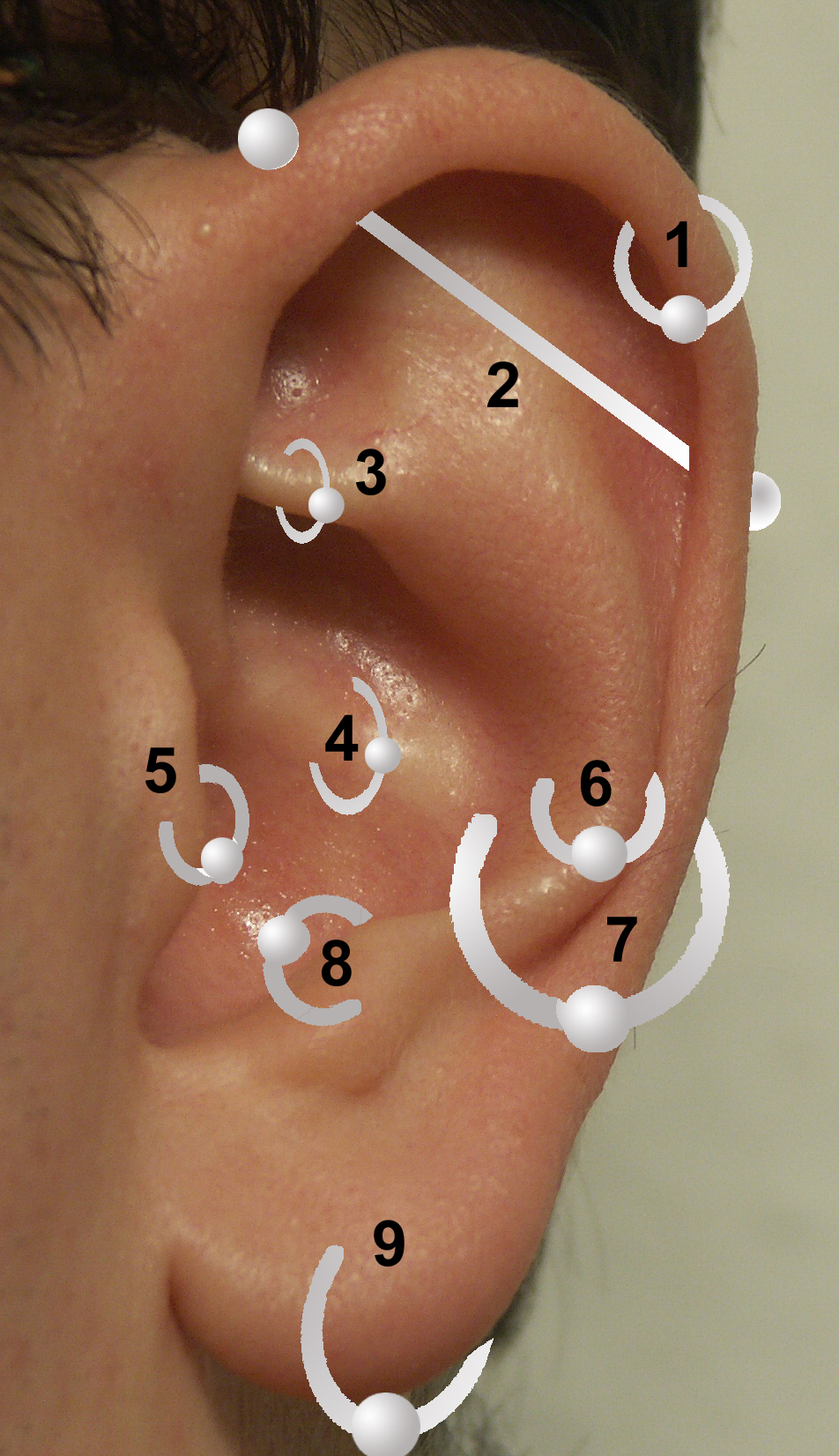
Ear lobes
Fine. This is the most ordinary piercing in the world, worn by Catholic women for centuries and by plenty of men. Choose modest jewellery and you have nothing to worry about.
Ear cartilage, nose and eyebrow
Generally permissible. Nose rings are ancient (Genesis 24:47) and are traditional in many cultures, including in South Asia and the Middle East. Weigh the health risks of cartilage, the reaction of your parents and employer, and your motive.
Lip and tongue
Permissible in principle, unwise in practice. These carry the highest risk of dental damage and infection among common piercings, and in many places they still signal rebellion. Ask yourself hard questions about motive, and ask a dentist about the risks before you decide.
Navel
The real issue with a navel piercing is display. It exists to be seen, which usually means bare midriffs. Modesty "inspires one's choice of clothing" (CCC 2522), so if a navel piercing pulls you toward immodest dress, it is pulling you the wrong way.
Nipple and genital piercings
We advise against these firmly. They exist almost entirely for sexual display or sexual pleasure, they are hidden from everyone except a sexual partner, and they carry real medical risks. For an unmarried person, a piercing designed for sexual purposes is tied to a sexuality that belongs only within marriage (CCC 2350). For a married person, the question is whether it serves the love of the couple or a culture of sexual performance. Most honest answers lead away from the needle.
8. Is It a Sin for a Guy to Get His Ears Pierced?
No. A man wearing an earring is not committing a sin. Some Christians argue otherwise, usually from two verses, so here they are, weighed fairly.
Deuteronomy 22:5 says, "A woman shall not wear anything that pertains to a man, nor shall a man put on a woman's garment." Some read earrings as women's clothing. But Scripture itself shows men wearing earrings: Aaron collected rings from the ears of "your wives, your sons, and your daughters" (Exodus 32:2), and Gideon's enemies wore golden earrings "because they were Ishmaelites" (Judges 8:24). Earrings were not exclusively feminine in the biblical world, and they are not in many cultures today, from sailors to footballers.
1 Corinthians 11:14 asks whether nature itself teaches that long hair is degrading for a man. Paul is speaking about the customs of worship in Corinth, and the verse says nothing about jewellery.
The principle behind Deuteronomy 22:5 is still valid: men and women should not blur the difference between the sexes that God made good. If a man's jewellery is chosen to look feminine, or a woman's to look masculine, the motive matters. A plain stud does not do that. The Catholic view of biblical manhood is about courage, sacrifice and protecting others, and an earring neither adds to it nor takes away.
Stop asking only "is it allowed?" Start asking "who am I becoming?"
The real question behind every piercing is identity. Pro helps you answer it with Scripture and prayer: in-depth Bible studies, audio devotionals, audio-guided prayers for anxiety and the hard days, a circle of believers, and counselling with a qualified therapist if body image or self-worth has become a struggle. Why only $49 once when the big prayer apps charge $59.95 to $100 a year? It is all digital, made once and shared with every member, with no office or agency to pay for. We are rooting for you. Pay once, keep it for life, and take the 30-day money-back guarantee if it does not help.
Get Pro for $49 $49 one-time. Lifetime access, no subscription. 30-day money-back guarantee.9. Six Questions to Settle Before You Get Pierced
Prudence is "right reason in action" (CCC 1806, quoting St. Thomas Aquinas). Before you book, settle these six questions honestly. If any answer troubles you, wait.
- Why do I want it? Name your motive in one sentence. If the honest sentence includes "to annoy," "to be noticed sexually" or "to feel something," stop.
- What does it say? Jewellery can carry symbols. Pentagrams, demonic imagery, occult sigils and "protective" charms are off limits (CCC 2117). A cross, a Miraculous Medal charm or a plain stud are fine.
- What do my parents say? If you live under their roof, obey them. If you are an adult, give their view a fair hearing.
- What will it cost my future? Some jobs, schools and vocations limit visible piercings. Think about the person you hope to be in ten years.
- Is it safe? Licensed piercer, sterile equipment, proper aftercare, and honest advice about risk for the placement you want.
- Can I afford it? If you owe money, or your family needs it, the piercing waits. Stewardship is a moral duty.
A simple 30-day plan
- Day 1: Write down the piercing you want and your motive in one honest sentence. Tell God about it in prayer.
- Days 2 to 7: Talk to your parents (if you live at home) or a trusted Catholic friend. Ask them what they see in your motive.
- Days 8 to 21: Research a licensed piercer, the healing time and the risks for that placement. If it is a lip, tongue or cartilage piercing, ask a dentist or doctor.
- Days 22 to 30: Wear the style as a clip-on or magnetic version if one exists. Notice how you feel and how you dress around it.
- Day 30: Decide. If you still want it for a good reason, go ahead with a clear conscience.
Pray about it through the whole month. Bring it to God honestly and see whether the desire grows or fades. Impulse is the enemy of prudence.
Make prayer the first step of every decision. Pro's audio-guided prayer sessions and prayer frameworks teach you to bring ordinary choices to God before you make them. Get Pro for $49. Is $49 a lot? You pay once, it lasts a lifetime, and it comes with a 30-day money-back guarantee.
10. What Do Other Christians Say About Piercings?
Christians disagree on piercings, mostly along the lines of how they read Scripture on adornment.
- Holiness Pentecostal churches. Some holiness and Oneness Pentecostal churches, including many congregations of the United Pentecostal Church International, teach "holiness standards" that discourage or forbid jewellery for members, usually citing 1 Timothy 2:9 and 1 Peter 3:3.
- Plain churches. The Amish and conservative Mennonite communities avoid jewellery as part of plain dress, out of humility and separation from the world.
- Seventh-day Adventists have historically discouraged jewellery as a matter of simplicity, though practice varies today.
- Most evangelicals and mainline Protestants treat piercings as a matter of Christian liberty and modesty, close to the Catholic view.
- The Orthodox have no prohibition, and earrings are traditional for women in many Orthodox cultures.
The Catholic response to the strictest view is respectful and firm. 1 Timothy 2:9 and 1 Peter 3:3 warn against ostentation and against putting appearance before holiness. Read literally as a ban, they would also forbid braided hair and any gold, which no Christian community applies consistently. The Church has always read them as a call to modesty and priorities. Christians who choose plainness for the sake of humility are making a beautiful choice. They should not bind it on everyone.
11. For Parents and Teens
Teens: if you live under your parents' authority, obey them on this. The Fourth Commandment is clear (CCC 2217), and a piercing can wait. Many places require parental consent for minors, and good piercers will refuse you without it. Use the time to be sure you still want it, and to show your parents you can make a mature decision.
Parents: argue from principle. If you say "piercings are a sin," your teenager will find Genesis 24:47 in a minute and stop listening. Say what is true: "The Church allows piercings. I want you to think about why you want this, where, and what it says, and I want you to wait until we agree or until you are an adult." Keep talking. A teen who feels heard is far less likely to rebel with a needle.
When it is about pain
Piercing is different from self-harm. But if someone is piercing repeatedly to feel pain, to punish themselves, or to cope with overwhelming feelings, that is a sign of real suffering that deserves care. You are not alone, and you are not bad. Talk to a doctor, a counsellor or a trusted adult today. A Catholic therapist can help; the directory at CatholicTherapists.com lists therapists who share the faith.
- US: call or text 988 (Suicide and Crisis Lifeline)
- UK and Ireland: Samaritans on 116 123
- Australia: Lifeline on 13 11 14
- Elsewhere: find a local line at findahelpline.com
12. What About Piercings You Already Have?
Most piercings you already have need no action at all. If your piercing is ordinary and your motive was ordinary, there is nothing to confess and nothing to remove. Enjoy your earrings.
If you got a piercing for a sinful reason, such as defying your parents, sexual display or vanity that had become obsessive, confess the motive. The piercing itself can stay or go as prudence suggests. If the jewellery carries occult or obscene symbols, replace it today. If a piercing is tied to sexual activity outside marriage, or keeps you in a mindset you want to leave, take it out and let it close. Many piercings heal over in time once the jewellery is removed.
If you are looking back on a stage of life you regret, remember that When God looks at you, he sees his child. "If any one is in Christ, he is a new creation; the old has passed away, behold, the new has come" (2 Corinthians 5:17). Go to confession if you need to, and move forward in peace.
New creation, new habits. Pro gives you a daily rhythm of prayer with audio devotionals, Bible studies and a circle of believers to pray with, so the person you are becoming has something solid under them. Get Pro for $49 once, no subscription, 30-day money-back guarantee.
13. The Verdict
Piercings are not a sin in themselves. The Bible never bans them and shows God's people wearing them, Leviticus 19:28 does not address them and does not bind Christians as ceremonial law, and the Catholic Church leaves them to prudence. Ear piercings are fine. Nose and cartilage piercings are generally fine with care. Tongue and lip piercings are permissible and usually unwise. Intimate piercings and extreme modifications should be refused. Every piercing is judged by motive, modesty, symbolism, health, obedience and cost.
Here is the harder word. Most people who search this question are hoping for a quick yes or no about a piece of metal. God is far more interested in the heart behind it. Are you adorning yourself to be loved because you do not believe you already are? No one knows the day or the hour (Mark 13:32), and on that day nobody will ask about your ears. They will ask what you did with the heart God gave you. Settle that first, today.
Bottom line: a piercing is permitted, a sinful motive is not, and the jewel God values most is a gentle and quiet spirit.
Wear what you like. Become who God made you.
Pro gives you everything for a daily walk with Christ: audio-guided prayers for morning and night, audio devotionals, the full study library, worship playlists, offline access, a circle of believers and counselling sessions with a qualified therapist. Why only $49 once when the big prayer apps charge $59.95 to $100 a year? It is all digital, made once and shared with every member, with no office or agency to pay for. We are rooting for you. No purchase changes your standing before God. Pro is material and community for daily practice. Try it for 30 days, and if it does not help, take the refund.
Get Pro for $49 $49 one-time. Lifetime access, no subscription, no renewal. 30-day money-back guarantee.Prefer to support this ministry instead? Make a donation.