1. Is It a Sin to Get a Tattoo?
No. A tattoo is not a sin in itself, and the Catholic Church has never made a law against tattoos. You will search the Catechism of the Catholic Church in vain for a ban. Catholics in good standing, including Catholic communities with ancient roots, have worn religious tattoos for centuries.
Here is the verdict, plainly: a Catholic may get a tattoo, provided the image is good, the motive is right, and the decision is prudent. Get those three wrong and a tattoo can absolutely become sinful. An obscene image, a demonic symbol, a charm meant to protect you, a tattoo meant to wound your parents, or a sleeve paid for with your rent money: those are real sins, and no amount of "it's just art" changes it.
People who tell you every tattoo is a sin usually point to one verse, Leviticus 19:28. People who tell you nothing about tattoos matters usually ignore the questions of motive and content entirely. Both are wrong. This guide walks you through the verse, the Church's actual position, the Christian tattoo traditions most people never hear about, and the hard questions to settle before you book the appointment.
Thinking of putting Scripture on your skin? Put it in your heart first. Pro gives you the full study library of in-depth Bible studies, audio devotionals and audio-guided prayer. Get Pro for $49 once, lifetime access, 30-day money-back guarantee. Start reading the Word today.
2. What Does Leviticus 19:28 Actually Say?
Leviticus 19:28 forbids cutting the body for the dead and tattooing: "You shall not make any cuttings in your flesh on account of the dead or tattoo any marks upon you: I am the LORD" (Leviticus 19:28, RSV). It is the only verse in the Bible that names tattooing, and the context explains what it targeted.
Read the surrounding verses. Leviticus 19:26 forbids divination and soothsaying. Verse 27 forbids rounding off the hair on your temples or marring the edges of your beard. Verse 28 forbids cutting your flesh for the dead. Verse 31 forbids turning to mediums and wizards. The chapter is building a fence around Israel to separate her from the religious practices of the nations around her, including pagan mourning rites in which worshippers cut and marked their bodies for the dead or for their gods. Deuteronomy 14:1 repeats the point: "you shall not cut yourselves or make any baldness on your foreheads for the dead." When the prophets of Baal wanted their god to answer, they "cut themselves after their custom with swords and lances" (1 Kings 18:28).
The same chapter of Leviticus also forbids sowing a field with two kinds of seed and wearing a garment of two kinds of material (Leviticus 19:19). Very few Christians who quote verse 28 against tattoos check the labels in their clothes. That inconsistency tells you something: verse 28 belongs to a body of law that Christians have never kept as binding.
Verse 28 still teaches something true. God cares what we do with our bodies, and he does not want his people branding themselves for false gods or the dead. That principle stands, and it drives the hard line on occult tattoos below.
3. Why Doesn't Leviticus 19:28 Bind Christians?
Leviticus 19:28 does not bind Christians because it belongs to the ceremonial law of the Old Covenant, which was fulfilled in Christ. Catholic theology, following St. Thomas Aquinas, distinguishes three kinds of precepts in the Law of Moses: moral, ceremonial and judicial (Summa Theologiae I-II, q. 99). The moral precepts, summed up in the Ten Commandments, express the natural law and bind every human being forever. The ceremonial and judicial precepts governed Israel's worship and civic life, and they passed away with the coming of Christ.
The early Church settled this at the Council of Jerusalem, which refused to impose the Law of Moses on Gentile believers and asked only a few things of them (Acts 15:19-29). Jesus himself declared all foods clean (Mark 7:19). The Letter to the Hebrews says that in speaking of a new covenant God "treats the first as obsolete" (Hebrews 8:13).
So the honest question for a Christian is never "does Leviticus allow it?" The honest question is whether this particular tattoo breaks the moral law: does it honour God, respect your body, avoid scandal, avoid superstition, and come from a free and well-ordered heart? That is the test the rest of this guide applies.
4. Does the Catholic Church Forbid Tattoos?
No. The Catholic Church has no canon, catechism paragraph or papal decree forbidding tattoos. What the Church does give is a set of principles about the body, and they apply to ink as much as to anything else.
- Your body is holy. "Do you not know that your body is a temple of the Holy Spirit within you, which you have from God? You are not your own; you were bought with a price. So glorify God in your body" (1 Corinthians 6:19-20). A tattoo should never deface that temple with what is shameful.
- Health is a gift to protect. "Life and physical health are precious gifts entrusted to us by God. We must take reasonable care of them" (CCC 2288). That means a clean, licensed studio and sterile equipment, and it means no back-alley needle.
- The body is no idol. The Church "rejects a neo-pagan notion that tends to promote the cult of the body, to sacrifice everything for its sake, to idolize physical perfection" (CCC 2289). If your skin has become your religion, the problem is bigger than any single tattoo.
- Modesty and purity of heart. Modesty "protects the intimate center of the person" (CCC 2521). Placement, content and the way a tattoo is shown off all fall under it.
- No superstition or magic. The First Commandment forbids attributing magical power to signs and objects (CCC 2111, 2117). A tattoo meant to protect you, bring luck or bind a spirit crosses that line.
Inside those principles, tattoos fall into the area the Church leaves to prudence. Prudence is the virtue that "disposes practical reason to discern our true good in every circumstance and to choose the right means of achieving it" (CCC 1806). Use it.
Mark your soul before you mark your skin
A cross on the wrist means most when the cross is carried every day. Pro gives you audio devotionals for commutes and quiet moments, audio-guided prayer sessions, the full study library of in-depth Bible studies and prayer frameworks, worship playlists, and a circle of believers to pray with. Why only $49 once when the big prayer apps charge $59.95 to $100 a year? It is all digital, made once and shared with every member, with no office or agency to pay for. We are rooting for you. Will you actually use it? It works offline and you keep it for life, and if it does not help within 30 days, you get your $49 back. No one knows the day or the hour (Mark 13:32). Build the faith the tattoo is meant to show, starting today.
Get Pro for $49 One payment, lifetime access, no subscription. 30-day money-back guarantee.5. Christian Tattoo Traditions: Copts, Croats and Pilgrims
Christians have tattooed the cross on their bodies for centuries, often as a badge of faith under persecution. These traditions are the strongest historical answer to the claim that tattoos are inherently unchristian.
The Coptic wrist cross
Many Coptic Christians of Egypt wear a small cross tattooed on the inside of the right wrist, often received in childhood. In a country where Christians are a minority and have faced waves of persecution, the cross marks a person as Christian for life and makes quiet apostasy impossible. Copts commonly show the tattoo as a sign of belonging. The Coptic Church is part of the Oriental Orthodox communion, and the Coptic Catholic Church shares its heritage. See our guide to the Coptic Orthodox Church.
Sicanje: the Catholic crosses of Bosnia and Herzegovina
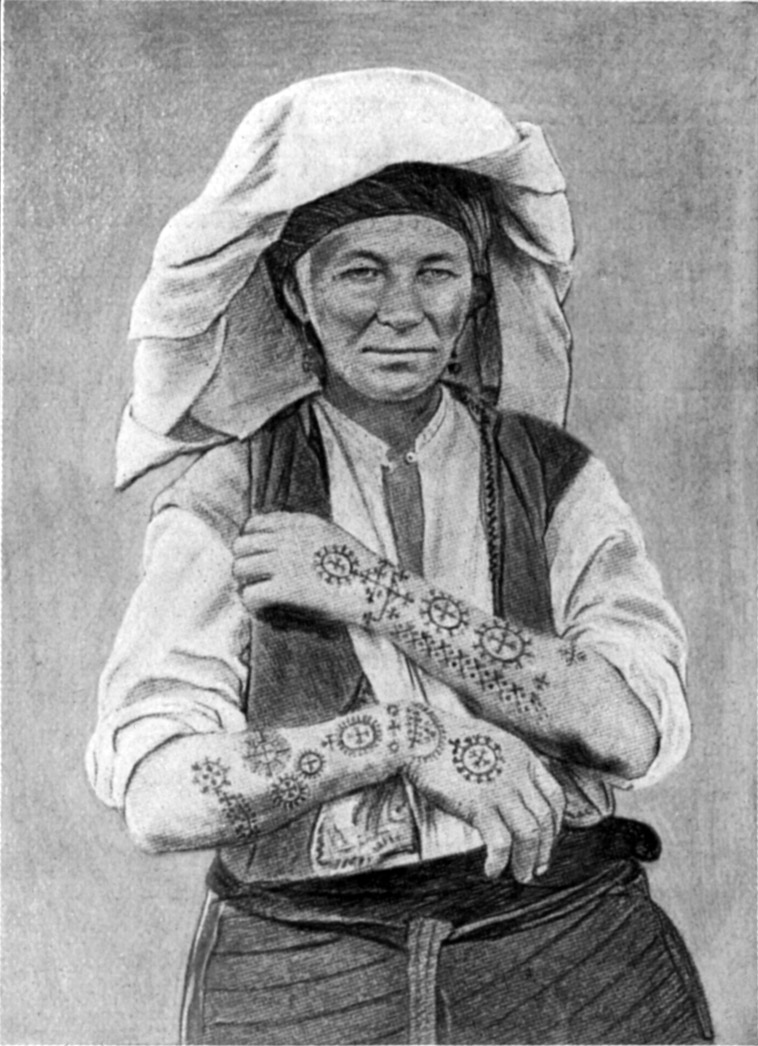
Catholic Croat women in Bosnia and Herzegovina practised a tattoo custom called sicanje (also bocanje), marking the backs of the hands, the fingers, the forearms and sometimes the chest or forehead with crosses and geometric designs. The custom is strongly associated with the centuries of Ottoman rule, and the usual explanation is that the crosses marked girls as Catholic and made it harder to force them into conversion or marriage outside the faith. Historians debate how old the custom is and how much of its design predates Christianity in the region, but for generations the tattooed cross was a mark of Catholic identity. Older women with these tattoos could still be found in the twentieth century, and some Croats today revive the designs as a tribute to their grandmothers.
Pilgrim tattoos
In Jerusalem, Christian tattooists have marked pilgrims with crosses and holy designs for centuries. The Razzouk family, Coptic Christians, are the best-known family of pilgrim tattooists in the Old City and say they have carried the craft for many generations. In Italy, pilgrims to the Holy House of Loreto were tattooed with Marian and devotional designs as a souvenir of their pilgrimage, a custom that lasted into modern times.
None of this means every tattoo is holy. It means the Church has lived with Christian tattooing for a very long time without condemning it. The Scriptures even offer the image: "another will write on his hand, 'The LORD's'" (Isaiah 44:5), and God says of his people, "I have graven you on the palms of my hands" (Isaiah 49:16).
6. Six Prudence Questions to Settle Before You Get Inked
Answer these six questions honestly, on paper, before you book. If any answer makes you squirm, wait.
- Content: is the image good? Would you be at peace showing it to Christ? Obscenity, nudity, glorified violence, hate symbols, gang signs, occult symbols and mockery of the faith are out. Full stop.
- Motive: why do I want this? To honour God, remember a loved one, mark a conversion or a vocation: good motives. To shock, to rebel, to belong to a group that despises the faith, to hurt someone, or to feel worth something: bad ones. Name the real reason, and let God see it.
- Vanity: is this about being seen? Everyone likes to look good, and that is no sin. But if you keep needing the next piece to feel like yourself, if your body has become a project to curate for likes, the tattoo is feeding pride. Read our guide on pride.
- Cost: can I actually afford it? Large tattoos cost a great deal, and good removal costs far more. If you are behind on rent, carrying credit card debt, or not giving anything to God or the poor, a sleeve is the wrong place for that money. Our guide to debt and money stress is blunt about this.
- Permanence: will I want this at sixty? A partner's name, a band, a trend, a joke: these age badly. Wait at least six months with any design. If you still want it after half a year, that tells you something.
- Others: whom does it affect? Your spouse deserves a say over your shared body (1 Corinthians 7:4). Your parents deserve respect. Your future employer, your children and your parish may read the tattoo in ways you do not intend. Scandal is real.
Struggling to tell your real motive? Bring it to prayer before you bring it to a studio. Pro's audio-guided prayer sessions and prayer frameworks help you sit with God and listen. Get Pro for $49, once, with a 30-day money-back guarantee.
7. Occult, Pagan and Demonic Imagery: The Hard Line
Never tattoo occult, satanic, magical or pagan religious symbols on your body. This is the one area where the Leviticus principle still burns hot: God's people do not brand themselves for other powers. The Catechism condemns "all practices of magic or sorcery, by which one attempts to tame occult powers" and says even wearing charms is reprehensible (CCC 2117).
That rules out, among others:
- pentagrams and inverted crosses, sigils, demon names or images, and the "number of the beast" used as a boast;
- runes, symbols or mantras chosen for their supposed power to protect, bring luck, ward off evil or attract love;
- tarot cards, zodiac signs or astrological charts chosen because you believe they define or guide you;
- the gods and spirits of other religions as objects of devotion, or symbols from witchcraft and neo-pagan ritual;
- anything a "spiritual" tattoo artist offers to charge with energy, bless with a ritual or align with your chakras.
Context matters. A historically Christian Celtic knot is no rune, and a Latin phrase is no spell. But if the point of the image is power, protection or identity drawn from anything other than Christ, do not put it on your body. Our guide to tarot, astrology and the occult explains why the "just aesthetic" excuse fails.
If you already carry such a tattoo, do not panic, and do not assume you are cursed. Renounce what it stood for, out loud. Confess any occult involvement. Ask a priest to pray with you. Then cover or remove the design when you reasonably can. For persistent spiritual trouble connected with past occult practice, read our guide to spiritual warfare and talk to your parish.
8. What Do Protestants, Orthodox and Others Say About Tattoos?
Christians disagree on tattoos more than Catholics do, so it helps to know where the people around you stand.
- Many conservative Protestants, especially in some Baptist, holiness and independent fundamentalist churches, teach that Leviticus 19:28 still forbids tattoos, or treat tattoos as worldly and immodest. Some churches and Christian schools ban visible tattoos for staff.
- Most evangelicals today treat tattoos as a matter of Christian liberty, citing Romans 14 and the freedom of conscience, and many young evangelicals wear Scripture tattoos.
- Pentecostals vary widely by church and country, from strict prohibition to open acceptance.
- Orthodox and Oriental Orthodox Christians include the Coptic and Ethiopian traditions where religious tattoos are common, alongside Orthodox clergy elsewhere who discourage them.
- Jewish tradition, which still keeps Leviticus, has generally forbidden tattoos.
The Catholic position sits between strict prohibition and careless permission: no ban, and real moral questions. If you belong to a family or church that holds a stricter view, honour them with charity. Paul's rule applies: do not let your freedom become a stumbling block to someone weaker in conscience (1 Corinthians 8:9).
9. Regret, Removal and Tattoos You Already Have
If you already have tattoos, you do not need to remove them to be a good Catholic. A tattoo you got before your conversion, in a wild season or on a bad night is part of your story, and God writes straight with crooked lines.
- If the tattoo was sinful (occult, obscene, hateful, or done to wound someone), confess the sin. Confession forgives the act. Then decide about the mark.
- If the content is evil or obscene, cover it in public and arrange to cover or remove it when you reasonably can. A skilled artist can often turn a bad tattoo into a good design.
- If you simply regret it, you are free to keep it. Many converts keep old tattoos as a reminder of where grace found them.
- Removal usually means repeated laser sessions, and it is expensive and painful. See a qualified clinic, and ask about risks.
Do not let shame about a tattoo keep you out of a church. Priests, deacons, religious sisters and saints-in-the-making walk into Mass every Sunday with ink on their arms. The Lord looks on the heart (1 Samuel 16:7).
Let the Word go deeper than the ink
Whatever you decide about the tattoo, decide today to know Christ better than you know any design. Pro gives you the in-depth Bible studies, prayer frameworks, audio devotionals and guided prayers that turn faith into a daily habit, plus a circle of believers to pray with and counselling with a qualified therapist when life gets heavy. Why only $49 once when the big prayer apps charge $59.95 to $100 a year? It is all digital, made once and shared with every member, with no office or agency to pay for. We are rooting for you. Pay $49 once, keep it for life, and claim the 30-day money-back guarantee if it is not for you. No one knows the day or the hour (Mark 13:32). Get Pro. Start now.
Get Pro for $49 One payment, lifetime access, no subscription. 30-day money-back guarantee.10. If You Get One: Choosing a Faith Tattoo Well
If you have prayed about it and decided to get a religious tattoo, do it well. A sloppy faith tattoo is a public witness too.
- Choose a symbol with deep roots: the cross, the Chi-Rho, the ichthys fish, the Sacred Heart, a Marian monogram, the anchor of hope (Hebrews 6:19), a patron saint's symbol.
- Check every word. Misspelled Latin, Greek and Hebrew tattoos are a running joke for a reason. Ask a priest or a scholar to proofread the text and the reference.
- Pick a verse you will still pray at eighty. Read it in context first. Jeremiah 29:11 was spoken to exiles, and Philippians 4:13 was written about contentment in hardship. Know what you are wearing.
- Choose placement with modesty in mind. Ask whether you would be comfortable at Mass, at a funeral and at a job interview.
- Pick a clean, licensed studio and an artist whose work you have seen. Refuse anyone who offers rituals, "energy" or blessings of their own.
- Pray first. Ask for a blessing on the decision, and let the day become an act of devotion. Use the patron saint finder if you want a saint to honour.
11. For Parents and Teens
Teens: if you are under your parents' authority, honour and obey them on this. The Fourth Commandment is clear, and waiting costs you nothing. Many places require parental consent for anyone under eighteen, and reputable artists will refuse you anyway. Use the waiting time to test the design.
Parents: argue from principle. If you say "tattoos are a sin," your child will find the Coptic cross online in five minutes and stop listening. Say what is true: "The Church allows tattoos, and I want you to wait until you are an adult, think about the content and motive, and choose something you will still love." Then keep the conversation going.
When marking the body is a cry for help
Tattooing is different from self-harm. If you or someone you love is cutting or hurting themselves, that is a sign of real pain that deserves care, and you are not alone. Talk to a doctor, a counsellor, or a trusted adult today.
- US: call or text 988 (Suicide and Crisis Lifeline)
- UK and Ireland: Samaritans on 116 123
- Australia: Lifeline on 13 11 14
- Elsewhere: find a local line at findahelpline.com
12. The Verdict
A Catholic may get a tattoo. The Church has no ban, Leviticus 19:28 does not bind Christians, and Catholic and other Christian communities have worn the cross on their skin for centuries. But your body belongs to God, so the content must be good, the motive must be clean, and the decision must be prudent. Occult and obscene tattoos are sinful, and so is a tattoo born of rebellion, vanity or money you owed someone else.
Here is the harder word. A tattoo of a cross is easy. Carrying one is hard. Whatever you put on your arm, ask whether your life would convict you of belonging to Christ if the ink faded tomorrow. No one knows the day or the hour (Mark 13:32). Make sure the mark that matters most, the seal of your baptism, is alive in grace today. If it has been a while, go to confession this week.
Wear the cross. Then carry it, every day.
Pro gives you everything you need for a daily walk with Christ: audio-guided prayers for morning and night, audio devotionals, the full study library, worship playlists, offline access, a circle of believers and counselling sessions with a qualified therapist. $49 once. No subscription, ever. Why only $49 once when the big prayer apps charge $59.95 to $100 a year? It is all digital, made once and shared with every member, with no office or agency to pay for. We are rooting for you. If it does not help in 30 days, take the refund. No purchase changes your standing before God. Pro is material and community for daily practice, and it starts tonight.
Get Pro for $49 $49 one-time. Lifetime access, no subscription, no renewal. 30-day money-back guarantee.Prefer to support this ministry instead? Make a donation.